Bhutan District - Paro
Introduction
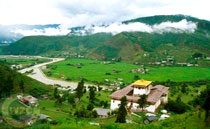
The town of Paro(2280m) lies in the centre of the valley on the banks of the Paro Chhu. It is is one of Bhutan's most impressive and well-known dzongs, and the finest example of Bhutanese architecture. The inward-sloping walls form a massive structure that towers over the town and is visible as a great white monolith from vantage points throughout the valley. The dzong's correct name, Rinchen Pung Dzong, means 'fortress on a heap of jewels'.
City at a Glance
|
Population |
39,800
(1980) |
|
Language |
Dzongkha |
|
Religion |
Buddhism |
|
Latitude |
7ºN |
|
Longitude |
89ºE |
History
In 1644, Shabdrung Ngawang Namgyal ordered the construction of the dzong on the foundation of a monastery built by Guru Rinpoche. One of Bhutan's strongest and most important fortresses, it was used on numerous occasions to defend the Paro valley from invasions by Tibet. The dzong survived the 1897 earthquake and caught fire only once, in 1907. The fire severely damaged the dzong, and it was rebuilt the following year. Large statues of Sakyamuni, Guru Rinpoche and Shabdrung Ngawang Namgyal were installed during the reconstruction.
Climate
Paro is the part of a country that displays more climatic changes in a small area than any other part of the world. While the day temperature in this region can go up to 15.50ºC, night temperature can go below the freezing point. Spring, mid - December to mid - January, is a beautiful experience here with clear blue sky and dry climate. Summer (May - August) is warm and wet and visibility is very low during this season. Autumn, October through November, is very mild with clear skies. The best time to visit Paro is spring when weather is at its best and blooming colours of nature makes it an unimaginable destination.
Attractions
Drukgyel Dzong:- 14km from Paro, stand the ruins of Drukgyel Dzong. This dzong was built in 1649 by Shabdrung Ngawang Namgyal in a location chosen for its control of the route to Tibet. The dzong was named ‘Druk’ (Bhutan) ‘gyel’ (victory) to commemorate the victory of Bhutan over Tibetan invaders in 1644.
National Museum:- National Museum of Bhutan is situated above the Paro Dzong in the old watchtower, one of the earliest constructed buildings in the country. The collection in the museum includes weapons and stamps, birds and mammals, and a good display of ancient Bhutanese art and artefacts.
Ugyen Pelri Palace:- Ugyen Pelri Palace is in a secluded wooded compound on the south side of the river just west of the dzong. This palace was built by the Paro Penlop, Tshering Penjor, in the early 1900s and is now a residence of the queen mother. It is designed after Guru Rinpoche’s celestial paradise, Zangto Pelri, and is one of the most beautiful examples of Bhutanese architecture.
Chhoeten Lhakhang:- Chhoeten Lhakhang, a large Bhutanese style chorten, is south of the town square.
Druk Choeding:- It is also known as tshongdoe Naktshang, Druk Choeding is the town temple. it was built in 1525 by Ngawang Chhogyel.
Dumtse Lhakhang:- To the west of the road is Dumtse Lhakhang, a chorten-like temple that is closed to tourists. This unusual building was built in 1433 by the iron bridge builder Thangtong Gyalpo. It has three floors representing hell, earth, heaven and the paintings inside are said to be some of the best in Bhutan.
Getting Around
Air Travel Resources:- Paro International Airport is the gateway to the country connected by national carrier Druk Air with Calcutta, Kathmandu, New Delhi, Dhaka, and Bangkok. The airline has only two aircraft with 72 seats each.
Land:- Paro is connected to Thimphu, the capital, with an all weather road. Public transport is served by the buses which are often crowded and you are advised not to use them. More often than not, you will visit Bhutan through a travel agency recognised by government of Bhutan. Make sure that your guide is waiting for you at the airport with the transport.
Shopping
Shops in Paro are open everyday. There are numerous handicraft shops throughout the valley.
Wildlife Sanctuaries