Bhutan District - Bumthang
Introduction
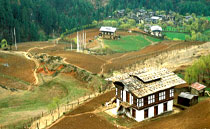
Bumthang valley lies at the altitude of 2600 metres. This valley is the religious heartland of Bhutan and home to some of the oldest Buddhist temples.
Bumthang is located in the east-central part of the country. This small region is surrounded by heavenly apple groves. It is one of the most beautiful regions in Bhutan. It encompasses four major valleys: Choskhor, Tang, Ura and Chhume. Because the dzongs and the most important temples are in the large Choskhor valley, it is commonly referred to as the Bumthang valley.
Attractions
Jakar Dzong :- It was founded by the great grandfather of Shabdrung. The Dzong was initially built as a Monastery in 1549 but was upgraded after Shabdrung had firmly established his power in 1646. Jakar Dzong is now used as the administrative center for Bumthang valley, and also houses the regional monk body.
Jambey Lhakhang :- It was built in the 7th century by a Tibetan King Songten Gempo. This is one of 108 monasteries which he built to subdue evil spirits in the Himalayan region. Its present architectural appearance dates from the early 20th century.
Kurje Lhakhang :- It is located above Jambey Lhakhang and consists of three temples. The middle temple is built on the site of a cave containing a rock with the imprint of the Guru’s body, and is therefore considered to be the most holy. The temple on the left was built in the 1990s by H.M. Ashi Kesang, the Queen Mother. These three temples are surrounded by 108 chorten walls. it takes about 30 minutes of hike north to reach Kurjey Lhakhang.
Tamshing Lhakhang :- It is located opposite of Kurje Lhakhang located opposite Kurjey Lhakhang was founded by Bhutan's religious treasure discoverer, Terton Pema Lingpa in 1501. There are very old religious paintings around the inner walls of the temple, which was restored at the end of the 19th century.
Thangbi Temple:- It was founded by Shamar Rimpoche in 1470, is located in the midst of buckwheat field. It is 17 Kilometers drive north of Kurjey Temple on an unpaved road to Toktu Zampa. This is the venue of Thangbi Festival.
Ura Village:- It is about 50 kilometers from Choekhor valley and takes about one and half hour. Ura village is a clustered of traditional houses fenced by cobblestone streets that give the village a mediaeval atmosphere. This is the venue for Ura Yakchoe Festival.
Adventure
There are many opportunities for hikes in the Bumthang region, most involving visits to remote goembas. You can walk the 17 km to Thankabi Goemba from Kurjey Lhakhang excursions. You can also walk to tharpaling Goemba over a aridge to Tharpaling goemba at 3500m in Chhume valley and then hike down to the road at Domkhar.
Wildlife Sanctuaries